




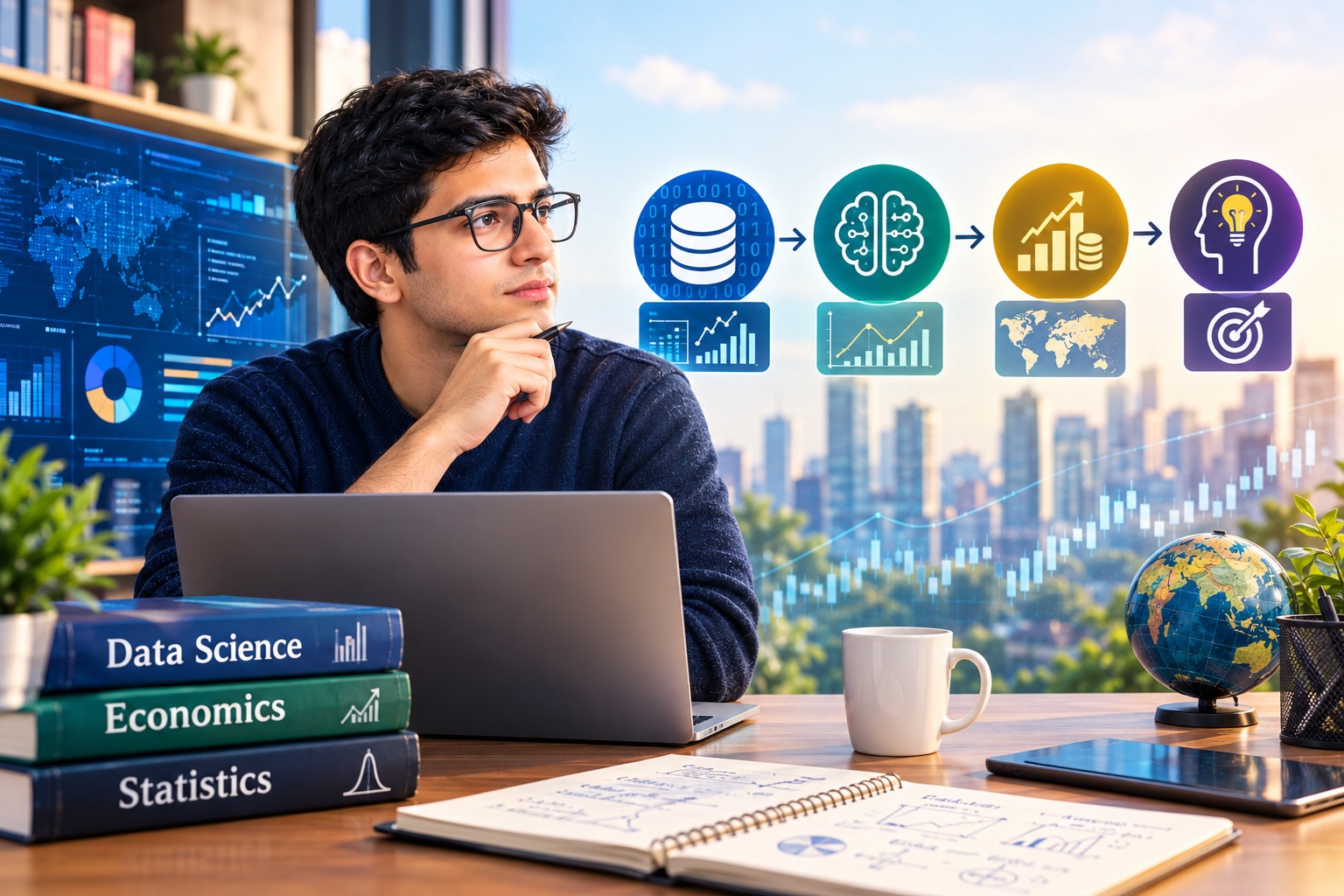
A Data Science Economics degree helps you connect hard math and coding with what happens in real business. You learn how to take messy data and turn it into useful ideas for economics. The program teaches you skills like making good guesses about the future and using computers for smart thinking. You also learn how to use numbers to solve big problems in the market. These tools help you make important choices in business.
The Intersection of Economics and Modern Data
Today, the world moves fast, and a lot of businesses create huge amounts of data every second. But this data on its own does not help much if there is no clear meaning or study done on it. If you do a data science masters program, you can learn how to turn data into real business steps that make sense.
By bringing together economic ideas and new computer tools, students get to learn how to find useful signals even when things seem unclear or confusing. In this way, they do not have to trust only old data or a gut feeling. Now, people making decisions can check their ideas and guess how markets may act in the future. They can trust the results more than before.
Core Technical and Analytical Skills You Will Master
A hybrid curriculum puts together the strong base of traditional economic study with up-to-date data work. You learn skills that help you face real numbers and problems you get in everyday life.
Econometrics Meets Machine Learning
Traditional economics looks at why things happen by using data and modeling. Machine learning is good at predicting what will happen next by finding patterns. A Data Science Economics degree shows you how to use both ways together. You learn to build tools that not only find good results, but also think about consumer choices and market changes.
Translating Complex Analytics into Strategic Decisions
Data is only useful if the main people for the job can see what it means and use it. Learning to make good code is not the only thing students learn. They also get:
● Interactive Visualization: Changing hard-to-understand regression results into easy dashboards. For this, you can use tools like Tableau, Power BI, or Python visualization libraries.
● Economic Storytelling: Making algorithm results into clear and simple stories for company leaders.
● Risk Assessment: Checking market uncertainty, how other businesses act, and big trends. This helps to lower business risks in daily work.
Career Opportunities for Graduates
Having a good grasp of data science together with a clear understanding of money matters opens doors to top jobs in many fields:
● Quantitative Economist: Looking at market trends and numbers to help banks or government offices with their money decisions.
● Data-Driven Strategy Consultant: Helping companies with ways to set prices, new growth plans, and moving to digital tools.
● People & Operations Analyst: Using predictions to make supply chains and how people or things are given out work better.
Frequently Asked Questions (FAQ)
Do I need a strong math background for a Data Science Economics degree?
Yes. You need to have a good base in math with linear algebra, multivariable math, probability, and simple statistics. This helps you get the skills you need for econometrics and machine learning in the program.
How does this degree differ from a standard Data Science degree?
While a typical data science course for computer science looks at software development, working with networks in computers, and building basic algorithms, a Data Science Economics degree is a bit different. It looks at how and why things happen, what motivates people, money planning, and how to use these ideas in real businesses.
Conclusion
Knowing how to use data and understand economic rules is now very important at work. People who can change data into solid market ideas can help lead teams in many fields. If you pick a focused path or go into a general data science masters program, you will learn skills that help you work with numbers and make good choices. These skills keep you ready for a world that uses more data each day.